Olaf, in comments, regarding China's unconditional loans vs. the highly-conditional IMF & World Bank loans and aid:
Are these conditions not what the left has been fighting and marching and protesting years to set up, in order to place environmental restrictions on corporations and governments?... I still have to wonder why China is willing to "offer more money at lower prices", but the IMF and WB aren't? I mean, if these loans are likely to be repaid, you'd think the IMF and WB would be interested, and if they're not likely to be repaid, you wonder why China IS interested.
The left has indeed been marching for
some conditions to loans, such as human rights, environmentalism and accountability. On that score, the World Bank and the IMF is still pretty pathetic. The main conditions that the Bretton Woods institutions have added in the last half-decade have been about "corruption", which was dodgy enough to begin with. Post-Enron, post-Worldcom, to have Washington lecture developed countries about corruption and transparency became... less tenable. Maybe not rightly, but that's the facts.
In general, I don't believe the left wanted
more conditions on IMF loans - which were already onerous. Maybe different conditions, and less of them. In particular,
I think the whole idea of "conditionality" needs to be abandoned when we're talking about some of the poorest places on Earth. Build roads, dams, and whatever else is necessary to give people the basic security that comes from leaving poverty, and then work on more substantive change. Additionally - and this is where the World Bank and the IMF failed miserably - work for development should use indigenous labour as much as possible.
In any case, the biggest plus to China's unconditional loans is that they aren't - as far as I've seen - coming with the baggage of the IMF's structural adjustment programs. These have, since the 1980s, totally dominated the foreign aid scene. There's little evidence they've stabilized the global financial scene, because various crises (Russia, Asia, Argentina, Turkey) all stemmed from
following the IMF's advice, not disobedience.
(For some good reading on this score, see Joseph Stiglitz, Dean Baker, or Robert Wade.)
Why isn't the World Bank or the IMF extending these loans? Probably because the countries in question can't swallow the IMF's conditions, and the IMF is still operating on the mentality that it's the only player that matters. Dean Baker has called the Bretton Woods institutions "the OPEC of money" because between the IMF and the World Bank, they could collectively decide whether a developing country has any access to capital at all. That was a position of incredible power, and they used it pretty mercilessly throughout the 1980s and 1990s.
Why is China extending these loans - even if we assume they won't be paid back? Two levels of self-interest here: One, investments that help the Pacific economy function more smoothly are, by definiton, good for China. So even if the loan doesn't get paid back, a bridge over the Mekong connecting Cambodia with southern China is A Good Thing.
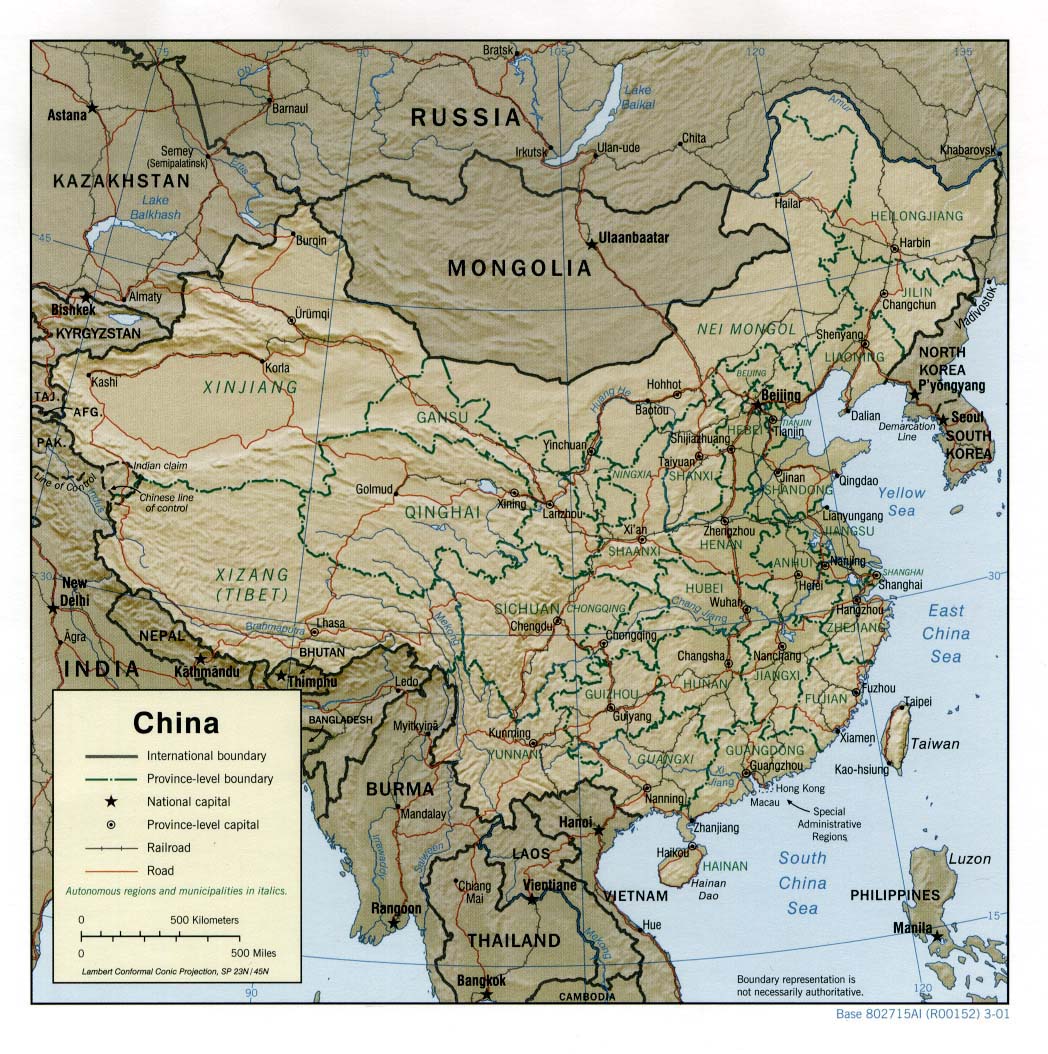
The deepwater port the article mentions in Myanmar is part of China's long-term strategy of trying to route as much of its imports as possible in to China without going through the Straits of Malacca - pirate-infested waters when they're not controlled by the Americans. Either way, it makes Beijing nervous. More broadly, Chinese investments in Myanmar's (Burma's) infrastructure, especially roads and bridges, could (and I have no evidence of this, just speculating) be an attempt to increase land trade with India. Currently, all of the main connections between India and China are along the Tibetan plateau, which means the travel times are slow and the passes are treacherous. More serious roads would greatly help Chinese-Indian trade, but it's difficult to carve roads and railways out of mountains. Consider that China just this year opened a rail line to Lhasa in Tibet, after controlling that country for decades.
So land connections along the Chinese-Indian border (Tibet) are possible, but not ideal. That leaves the option of roads and bridges through Myanmar, connecting with Indian trade along the Brahmaputra. There already seem to be road connections, based on
this map, but Wikipedia describes
Myanmar's economy thusly:
Today, Myanmar lacks adequate infrastructure. Goods travel primarily across the Burmese-Thai border, whence most illegal drugs are exported, and along the Ayeyarwady [Irriwaddy] River. Railroads are old and rudimentary, with few repairs since their construction in the 1800s. Highways are normally unpaved, except in the major cities.
So it's pretty clear Myanmar needs some cash before Chinese-Indian trade can really take off. In theory, a solid system of roads from India, through Myanmar, to Kunming could give Indian exports a much faster route between India and the Pearl River Delta (Guangzhou, Shenzen, Hong Kong) and the southern coast more generally. In theory, increased land traffic in the south would supplement the existing routes which connect India to Chengdu and Chungking in the interior.
Land connections between China and India via Burma have a history, however - the Japanese threatened to invade India during WWII after their quick victory over British, Chinese and American forces in Burma. Anyway, like I said I have no evidence of this, it's all just speculation based on map-reading and some educated guessing.
The second form of self-interest, and I think the more basic explanation for why China is throwing money at loans that may not ever get repaid, is simply that it's in Beijing's interest to make itself look like a more generous, benevolent, less actively imperial agent of development in Asia. This doesn't come cheap, but Beijing isn't trying to spend money everywhere. In Africa and the poorer parts of Asia, China is spending money smartly and creating a wedge between Washington and Beijing. Actually, that's not true: there was already a wedge between Washington and the developing world, created by the IMF and World Bank's arrogant assumption that it could dictate the terms of development ad infinitum. Beijing isn't pushing this wedge - yet - but unless Washington can come up with more attractive money (read: Cheaper and more plentiful) I don't see the US winning this game.
Whenever I write a number of posts about how competently China is playing the geopolitical game, I feel the need to write a disclaimer that, NO, I do not think Beijing is particularly benevolent, and NO I do not like the idea of a powerful authoritarian government supporting governments like Myanmar's or Sudan's. Nevertheless, China is not Doing Bad Things by building dams, roads, and bridges throughout Asia and Africa. Do we like the governments? No. Does that mean the people should live in poverty? Not on your life.


- "The rise of China presents the West, for the first time since the fall of the Berlin Wall, with a formidable ideological challenge to that paradigm."
- "The "China model" powerfully combines two components: illiberal capitalism, the practice and promotion of a governance strategy where markets are free but politics are not;..."
- "...and illiberal sovereignty, an approach to international relations that emphasizes the inviolability of national borders in the face of international intervention."
First of all, if there is a "China model", then there's a "Korean model", a "Taiwan model", a "Japan model" and a "Singapore model" too. Not to mention a "Spanish model", a "Brazilian model", an "Argentinian model" as well. All of these countries combined illiberal capitalism and a demand for inviolable national sovereignty throughout their history as well. In Taiwan, Japan and South Korea, it turned out that illiberal capitalism was unsustainable - increasing wealth led for demands of political change. You would think at the very least, having raised the Asian tigers as examples of countries where growth produced democratic regimes, you would then have to explain why the same doesn't apply to China. Barma and Ratner concede that some China moderates make this argument - that economic growth will make China a more friendly nation - and effectively ignore it for the rest of their article.This is an important point: Barma and Ratner are arguing that China poses a present and future ideological rival to the United States, but nowhere do they state or argue that China's current authoritarian government is sustainable over the long term. The most they say is thatOkay, here it's important to use proper words. The first important point is that calling the surge in rural protests an "uptick" is like calling the 2004 Asian tsunami "kind of a big wave." From the Rand Corporation:Nobody thinks that the current levels of protests threaten the regime, but we aren't seeing the protests level off, or even slow down. We're seeing exponential growth in protests, doubling in volume in less than a decade. For Ratner and Barma to dismiss this is astonishingly dishonest.
Secondly, the current Chinese regime is authoritarian and illiberal without question. But it is "totalitarian" only if we define "totalitarian" so broadly as to be meaningless. Indeed, the historical trend is exactly the opposite of what B&R charge - since the reforms of the 1970s, China has become a far more "privatized" society in the sense that religious freedoms and other forms of association outside of the Chinese Communist Party have become far more common. Outside of politics, it is possible to form independent associations (obviously, there are limits to these freedoms.) This is the exact opposite of the traditional definition of totalitarian - where all forms of social organization are controlled by the state.
Aside from their linguistic sloppiness, B&R engage in some truly stupid association:Boy, you'd think that Latin America had no history of charismatic populists using resource nationalism as the foundation of their power. And I'm sure that, until they visited Beijing, the Iranian Mullahs had never thought of shutting down newspapers or interfering with elections before. Yup, if it weren't for China, the Venezuelan and Bolivian poor would be just so happy to sell their oil to the US at $5/barrel, and pro-American (and dare I say it, pro-Israeli?) liberals would have won the last elections in Tehran. This kind of thinking is idiotic, and is beneath serious liberal thinking.
Moreover, it simply isn't liberal. Liberals are supposed to believe that humans are rational creatures with agency. Morales and Chavez have faced popular challenges, the democratic process, and have retained the majority support of the populations of their countries. That's simply a fact. Nobody except the embittered Venezuelan opposition seriously contends that these elections were rigged. So presented with that fact, you can either conclude that a) it's possible for leaders to do things American liberals disagree with, and still retain democratic legitimacy, or b) anyone who does anything that American liberals disagree with is by definition an autocrat in league with the ChiComs. Guess which one Barma and Ratner choose?
A side note: If Beijing really were capable of exporting "illiberal capitalism", you'd think that as a first step they'd have sold the Chinese people on it. They manifestly have not:Chinese "illiberal capitalism" doesn't even pose a serious ideological challenge in China, yet Barma and Ratner want us to believe it has global reach.
So at this point, Barma and Ratner have argued that China poses a new, long-term ideological rival to liberalism (false, or at least highly questionable) and that illiberal capitalism is new, dangerous, and is being exported by China to the developing world (simply false.) The final claim - that "illiberal sovereignty" undermines (American) "democratic liberalism" is similarly unsound. Basically, B&R argue that because of Beijing's largesse with foreign aid, the IMF and the World Bank can no longer force developing countries to adopt Washington's preferred policies on trade and human rights. This, according to B&R, is a bad thing. There's so much sloppiness here that we've got to take this one at a time.
1) When liberals say that Washington was promoting "trade and human rights" throughout the 1980s and 1990s, it's as noxious a rhetorical ploy as when Republicans say there's a problem with "Social Security and Medicare." There is no fundamental problem with SS, and a massive one with Medicare. Lumping them together is deliberately dishonest and serves an obvious political purpose. Similarly, there is no combined "trade and human rights" treaty. What there was, for almost all of the 1980s and 1990s, was a strict, enforceable, multilateral organization devoted to expanding trade, privatizing services, and opening countries to foreign investors. During the same time, there was only the barest, unenforceable, fig-leaf of a commitment to human rights. Washington's priorities were clear, and it wasn't making sure that Indonesians could vote.
2) There was never any coherent form of "liberal sovereignty" for China to undermine, even if we concede that's what China is doing. Washington aided and abetted the mass killings in Turkey and East Timor, and never tried to intervene against the Russians in Chechnya. During the same time, America twice went to war in Yugoslavia to stop the killing there. Given the respective contexts of these decisions, all of these actions may all be defensible, but they certainly can't fit in to any coherent idea of liberal sovereignty. Barma and Ratner:Here's the thing: neither did the United States or Europe until maybe 10 years ago. The idea of "selective sovereignty" only became accepted by the United Nations last year as part of the "responsibility to protect" doctrine. It is still incredibly controversial around the world, and highly contentious. Hell, I find the idea troubling some days. The fact that China does not agree with this idea is not an ideological challenge, unless - once again - simply disagreeing with American liberals makes you an autocrat. And American liberals need to stop talking about "promoting democracy overseas" for a while. Just sayin'.
3) There's no mystery to why China is finding so many countries willing, nay eager, to abandon the IMF and World Bank programs - they have singularly failed to produce the rapid growth that the developing world needs. Period. Full stop. Mark Weisbrot & Dean Baker, 2001:The results of IMF policies since that paper was published have been even worse (Argentina, anyone?) Furthermore, note Baker and Weisbrot's emphasis that development policies should allow countries "their own... paths to growth." Gee, sounds an awful lot like the sovereignty of national governments should be respected, don't you think?
So there was only a laughable attempt by Washington to promote human rights, there was never any coherent formulation of "liberal democratic sovereignty" for China to undermine, and even if that's exactly what China is doing, it might actually be a good thing for the poor of the world.
All told, Barma and Ratner have made not a single argument that can stand on it's own, and they certainly can't support their claim that China poses a unique or novel ideological threat western liberalism. What, then, is this argument really about? Ah, here we are:This is the nut of the issue, isn't it? American liberals have yet to formulate a foreign policy that doesn't rely on continuing the "permanence and projection of American power", as they put it. (Though Matthew Yglesias seems to be trying.) The growth of China's influence in the world may (or may not) be a threat to America's power, but it's hard for non-American leftists and liberals to see that as a bad thing either way. It's especially hard for countries who have been on the receiving end of American power to regret Washington's diminished importance.
Barma and Ratner want the rest of the world to weep for the end of American hegemony as much as they do, and they're not above trying to scare us about China to do so. It's factually wrong, it's logically incoherent, and it's dangerous to boot.
How very Republican of them.
All done!